 Charge
 Ambush
 Raid
Raid Predator
 Swarm
Swarm Flee
Flee Withdraw
 Standoff
Combat
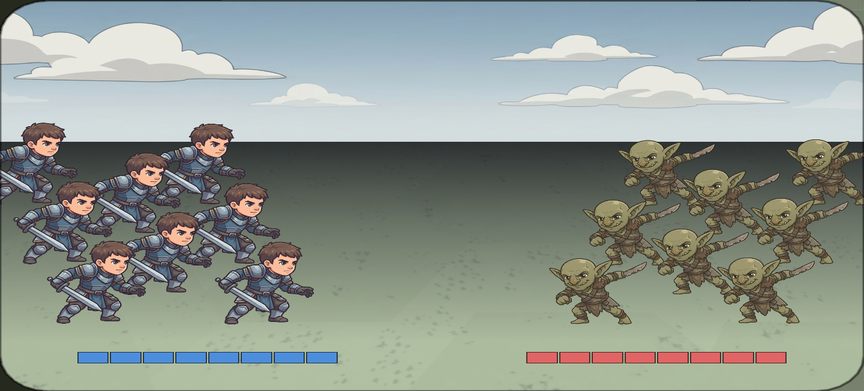
There is no randomness in combat. The same board and the same move always give the same result. You never lose a unit to bad luck — but when you lose, the reason is always somewhere on the board.
Resolved Simultaneously
Attacker and defender strike at the same time. There is no initiative. Losses for both sides are worked out from the strength each had before the fight and then applied together, so a single fight can wipe out both units.
A counterattack happens only when the unit is attacked at distance 1 and can shoot that distance itself. Attacks from distance 2 or more are never countered. Artillery with a minimum range of 2 or more cannot counter an adjacent enemy, and a unit without Atk vs Air cannot counter a flier.
Modifiers
- Lv
- Each level adds 1% to attack and defense. Fighting gives +1, and destroying the enemy gives another +1. A unit that could not counter gains nothing. The cap is 99.
- Effective Atk and Def
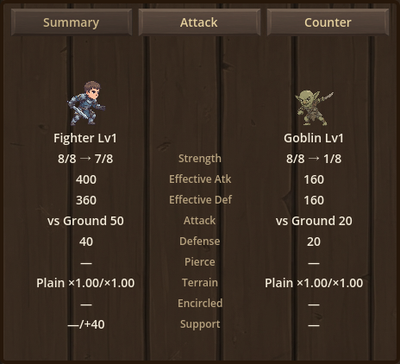
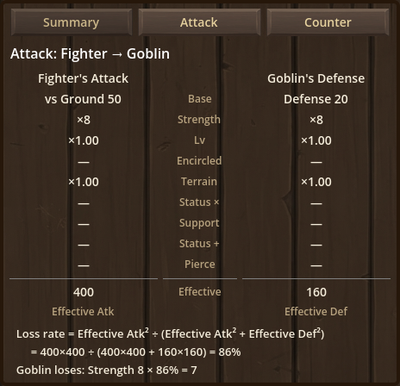
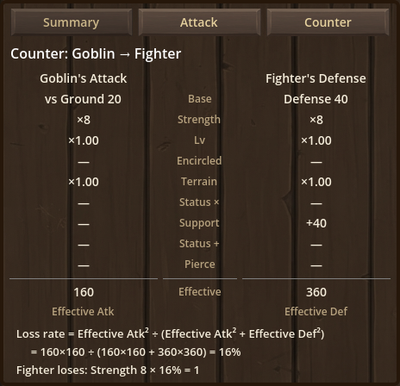
- A unit does not fight with its printed numbers. Strength is multiplied in, then the modifiers apply, giving the Effective Atk and Effective Def the report shows. Lv, Encircled, Terrain and Status Effects multiply; Support and Status Effects add. All the multiplying is done first, then the adding.
Effective Atk = Strength × Attack × Lv × Encircled
× Terrain × Status(×) + Support + Status(+)
Effective Def = Strength × Defense × Lv × Encircled
× Terrain × Status(×) + Support + Status(+) - Terrain
- The terrain a unit stands on applies its own factors, one for attack and one for defense. The attacker uses the attack factor of the hex under itself, and the defender uses the defense factor of the hex under itself.
- Encircled
- A penalty on the unit being surrounded. It takes two or more adjacent enemies to trigger, and the deeper the ring the further its attack and defense fall together. It applies in melee and at range alike. How the hexes are counted, and the numbers, are in the Encirclement chapter.
- Support
- A boost from adjacent allies. Either way, the allies who count are the ones standing next to the defending unit: attacking, that means allies adjacent to your target; defending, allies adjacent to you. Each supporting unit adds a quarter of its Strength × Attack (or Defense, when defending). Lv and terrain are not applied, and it scales with Strength, so a worn-down ally gives little. On defense the total is capped at twice the defense you had before support. A unit that surrounds an enemy doubles as a supporter. It applies at any distance, indirect attacks included.
- Status Effect
- Buffs and debuffs from skills. Some multiply and some add, and the report splits them into two rows: the multiplying one sits below Terrain and the adding one below Support, each beside the modifiers it groups with. A unit carrying one shows a ring at its feet — a thick inner ring for debuffs, a thin outer ring for buffs.
- Pierce
- The share of the target's defense that the attacker ignores. The harder the target, the more it pays off. It is applied last, after every other modifier, and only to the defender, so whatever Support added is cut down by it too.
How Losses Are Decided
How many soldiers are lost comes from the ratio of the attacker's Effective Atk to the defender's Effective Def. Evenly matched takes about half, twice the attack takes about eighty percent, half the attack takes about twenty.
The wider the gap the sharper it bites. An even brawl just grinds both sides down, so the game is about stacking modifiers before you commit.