
 Charge
 Ambush
 Raid
Raid Predator
 Swarm
Swarm Flee
Flee Withdraw
 Standoff
Encirclement
Surround an enemy and its attack and defense both fall. It takes two or more adjacent units to trigger; one on one, nothing happens. Nothing makes the attacker stronger — the surrounded unit gets weaker — so an enemy you have pinned is just as soft to a unit firing from afar. The same applies to you when you are the one surrounded.
How the Hexes Are Counted
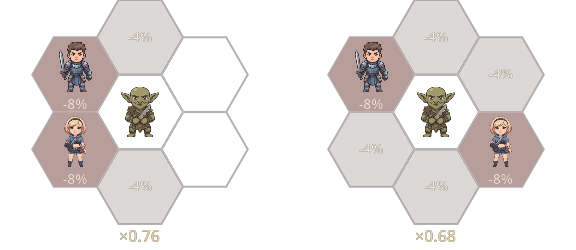
On the left, two surrounding units stand side by side; on the right, opposite each other. The strong red hexes hold a surrounding unit; the faint red ones are the hexes beside them. The number on a hex is what that hex takes off, and the one under the figure is the resulting Encircled factor.
A unit doing the surrounding is called a surrounding unit. The six hexes around the surrounded unit are counted in two ways: each hex holding a surrounding unit takes off 8%, and each empty hex beside a surrounding unit takes off 4%, lowering attack and defense together. It never drops below 10%. Hexes off the board are not counted, so units on edges and corners are hard to encircle.
Depth and the Number
| Shape | Surrounding units | Hexes beside them | Encircled |
|---|---|---|---|
| Two side by side | 2 | 2 | ×0.76 |
| Two with a gap | 2 | 3 | ×0.72 |
| Two opposite | 2 | 4 | ×0.68 |
| Three around | 3 | 3 | ×0.64 |
| All six hexes | 6 | 0 | ×0.52 |
A unit with no attack still counts as a surrounding unit, and so does one that has already acted, for as long as it stands on the board.